
My grandmother used to tell me something that made no sense at the time.
“Don’t marry someone,” she said, “unless you can travel together.”
I remember thinking what an odd requirement that was. What about all the other things people are supposed to look for, like love?
But she wasn’t wrong. She was pointing at something most of us don’t think to test for until we’re already buried deep in it. Because travel — real travel, the kind that doesn’t go as planned — has a way of showing you exactly who someone is when the plan falls apart.
I got a four-boat lesson in that this summer. And it turns out the same lesson was waiting for me back at work, on a shift I won’t forget.
This is an episode about what you actually learn about the people beside you when nothing goes according to plan.
The Real Test of Trust for Women Physician Leaders
Here’s what I’ve come to believe: the plan was never really the point.
We spend so much energy building the plan. The research and the packing list for that vacation. And also that treatment protocol and the staffing schedule. And then something happens that all the planning didn’t account for, and all that preparation buys you almost nothing.
What actually gets you through – it isn’t the plan holding up. It’s who’s still standing next to you when it doesn’t.
That’s as true on our summer sailing trip as it is in a hospital room. It’s very true in a marriage, which is probably what my grandmother was getting at all along.
The people who show up for you in chaos are telling you something true about themselves that calm days never will.
You don’t find out who your real team is on the easy shifts. You find out on the shifts where nothing works the way it’s supposed to.
So the question isn’t how do I control the chaos, because you won’t. The question is: who do you want beside you inside that chaos?
What Chaos Reveals About the People You’re With
This summer, my family went sailing. Or we tried to.
The original charter boat got beached two weeks before we arrived. The replacement boat sent my intuition into overdrive the second we stepped aboard, and it caught fire. Yes, it actually caught fire – nothing we could have planned for. Everyone got off safely, but that was boat number two, gone. Boat number three’s engine wouldn’t start. And we finally set sail on boat number four.
It was a long travel day followed by 36 hours of uncertainty. Everyone hot, tired, and running on frustration. My kids (and now I) tell this story by counting the boats.
Nothing we researched, nothing we packed for, prepared us for that particular send off. I’m a planner. I had no plan for this.
But somewhere in that mess, we made a choice to live our vacation inside the chaos. We took the dinghy to a nearby beach. We swam. We snorkeled. My kids did backflips off the dock with some local kids we’d just met. We had our first rum punch of the trip and a beautiful dinner, four boats and a full day late.
The trip nobody planned for has become the one we will reminisce about for years to come.
My kids tell that story with more delight than any of our other trips that went smoothly. Not because the chaos was fun in the moment. It wasn’t. But because we got through it together, and that’s the part that stuck.
What an ICU Transfer Taught Me About the Team I Trust Under Pressure
A few weeks after that trip, I was on shift, taking care of an eight-year-old with a complex medical history who came in with a respiratory illness. The kind we see constantly in pediatrics. Usually kids bounce back fast. This one didn’t.
Nothing turned the direction of her illness. Nothing we did plateaued it. She ended up going to the ICU that night.
That kind of night takes patience, focus, creativity, and knowing the limits of what you and your team can do. But what got me through it wasn’t a protocol. It was the respiratory therapist and the nurses at that bedside with me. Thought partners. People throwing out ideas, reconsidering timing, pushing what needed pushing, staying steady when I needed steady.
Afterward, what stayed with me wasn’t the diagnosis. It was noticing that everyone on that team cared about the outcome as much as I did, and brought the same level of skill to their piece of it that I was trying to bring to mine.
That’s when I realized my grandmother’s line has a version for medicine, too.
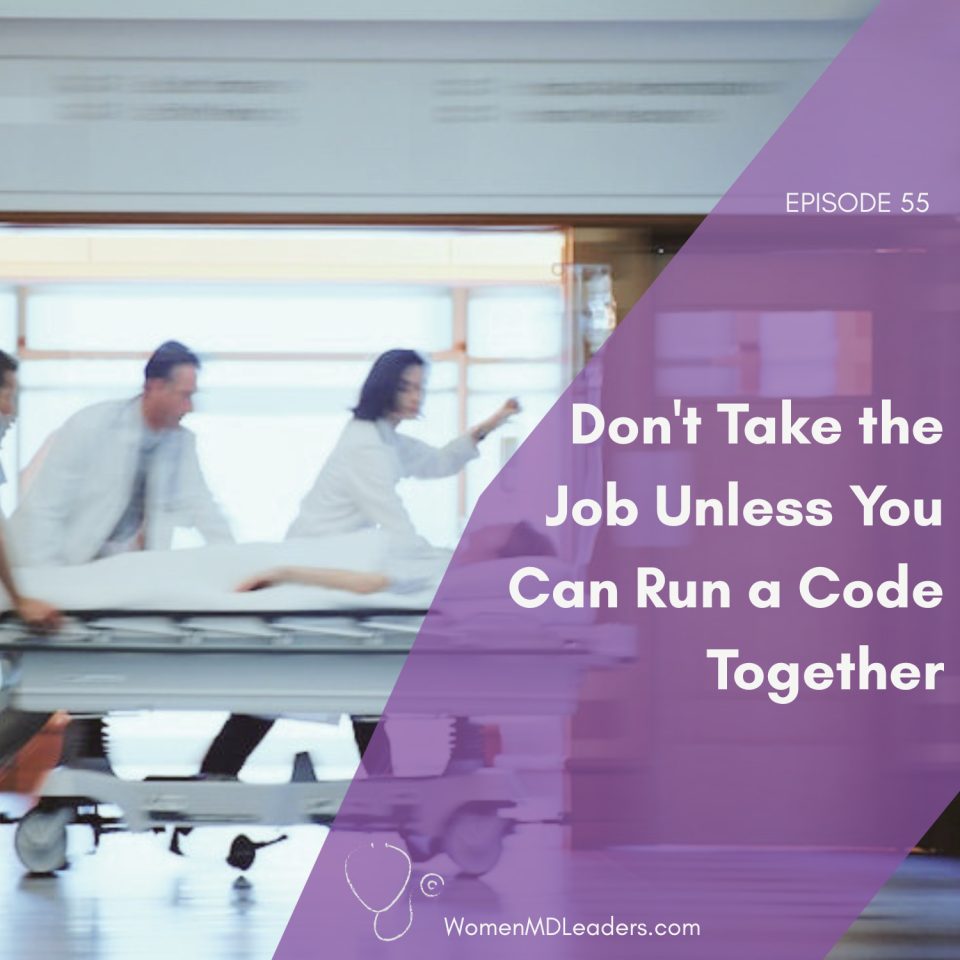
Don’t take the job unless you can run a code together.
Unless you can cover six hard shifts together and still trust the person next to you.
Boat number four didn’t teach me anything about picking a better charter company. It taught me how important it is to choose who you are standing next to when the plan doesn’t hold. That ICU shift taught me the same thing, just with a stethoscope instead of a life vest.
You don’t build that kind of trust on the easy days. You build it, or you find out you don’t have it, on the days everything falls apart.
Next Steps for Women Physician Leaders Ready to Know Who They Can Trust in Chaos
So here’s what I’d ask you to sit with this week.
Think about the last time something at work completely fell apart. Not a bad day. A genuinely unplanned, nothing-worked-the-way-it-should day.
Who was standing next to you? And when it was over, what did you learn about them that you didn’t know before?
If the answer makes you grateful, tell that person. Seriously. Send the text, the email, or the notecard. It matters more than you think.
And if the answer left you uneasy, if you realized you don’t actually trust the people next to you when things fall apart, that’s worth sitting with too. That’s not a small thing to notice about your team, or your unit, or your leadership.
I’ll leave you with my grandmother’s rule, expanded a little: don’t build your career, your team, or your life around people you haven’t traveled with. The easy days won’t tell you who they are. The “four-boat days” will.
Thanks for listening, and thanks for leading with heart.