
Why Women Physician Leaders Need Friendship for Mental Health, Longevity, and Burnout Prevention
Last night I was telling my husband, Sani, about a conversation I’d had with some of the neighborhood ladies earlier in the day.
He looked at me, a little confused, and said, “Wait… when did you see them?”
And that’s when I realized something.
I had treated that coffee date like it was just as important as any work meeting on my calendar that day.
Because it was.
Connection has always mattered to me — but only in recent years have I realized how essential it really is.
Not just for my happiness, but for my well-being… and honestly, for my family too. Because when I’m thriving, they feel it. When I’m supported, everyone does better.
Somewhere along the way, I stopped seeing connection as a luxury… and started seeing it as maintenance. As health.
It is something I have to schedule, protect, and honor — just like anything else that keeps me well.
And today, I want to talk about why that matters more than we realize — especially for high-achieving women in midlife.
Connection is Not Extra – It’s Foundational
For a long time, I thought connection was something you fit in if you had time. After the work was done. After the kids were cared for. After the responsibilities were handled.
But in reality, connection is one of the things that allows us to handle all of those responsibilities in the first place.
There’s a reason one of the childhood ACEs is maternal depression. When moms are depleted and struggling, kids feel it. Families feel it. Homes feel it.
When we are well, when we are supported, when we feel seen — everyone in our orbit does better.
And social connection is one of the strongest protective factors we have for our mental health.
Research consistently shows that strong social relationships are linked to lower risk of depression, better overall well-being, lower cardiovascular risk, and even longer life.
We talk about the loneliness epidemic, but we don’t always pause to ask ourselves if we’re quietly living inside it.
Connection isn’t indulgent. It’s protective.
Connection Changes with the Season of Life
When my kids were babies, the connection I protected most fiercely was with my husband.
We had a wonderful babysitter, and we set up a weekly date night. Even when we were exhausted. Even when we didn’t feel like going out. Especially at those times.
We kept that rhythm and made it simple because we knew we needed it.
That season required us to invest in our marriage.
Now we’re in a different phase of life. The kids are older. We’re less sleep-deprived. We naturally get more time together at home.
So the type of connection I need to be more intentional about has shifted.
Now, it’s connection with other women.
Women who add value and joy to my life. Women who understand the juggle. Women who remind me who I am outside of my roles.
Somewhere in midlife, this kind of friendship stopped taking a backseat and started feeling essential for my survival.
Or maybe it was always essential — it just floated back to the top of the priority list.
The Guilt That Tries to Stop Us
But let’s be honest about something.
There is often guilt that shows up when we take time for ourselves — especially time away from our families or our work.
I one hundred percent feel this often.
The voice that says:
- “You should be home.”
- “You should be working.”
- “Is this really necessary?”
We’ve been conditioned to believe that if we’re not producing, caregiving, or achieving, we’re being selfish.
But here’s the truth: your family, your patients, and your team need the supported, nourished, fulfilled version of you.
Connection is not taking away from them. It is fueling you so you can show up whole.
What Thriving Looks Like
When I imagine a woman aging with joy, resilience, and purpose, I picture my mother-in-law. She’s 85 and one of the most social people I know. She has multiple friend groups. She stays connected through phone calls, Facebook, WhatsApp, and social gatherings. Her world is full of people.
And despite the aches and pains that come with aging, she continues to thrive. I truly believe those connections are part of the reason.
A dear friend once told me that friendship takes commitment. That we have different friend groups that weave through different phases of our lives. Each one serves a purpose. Each one helps hold us up in a different way.
We have to nourish those relationships.
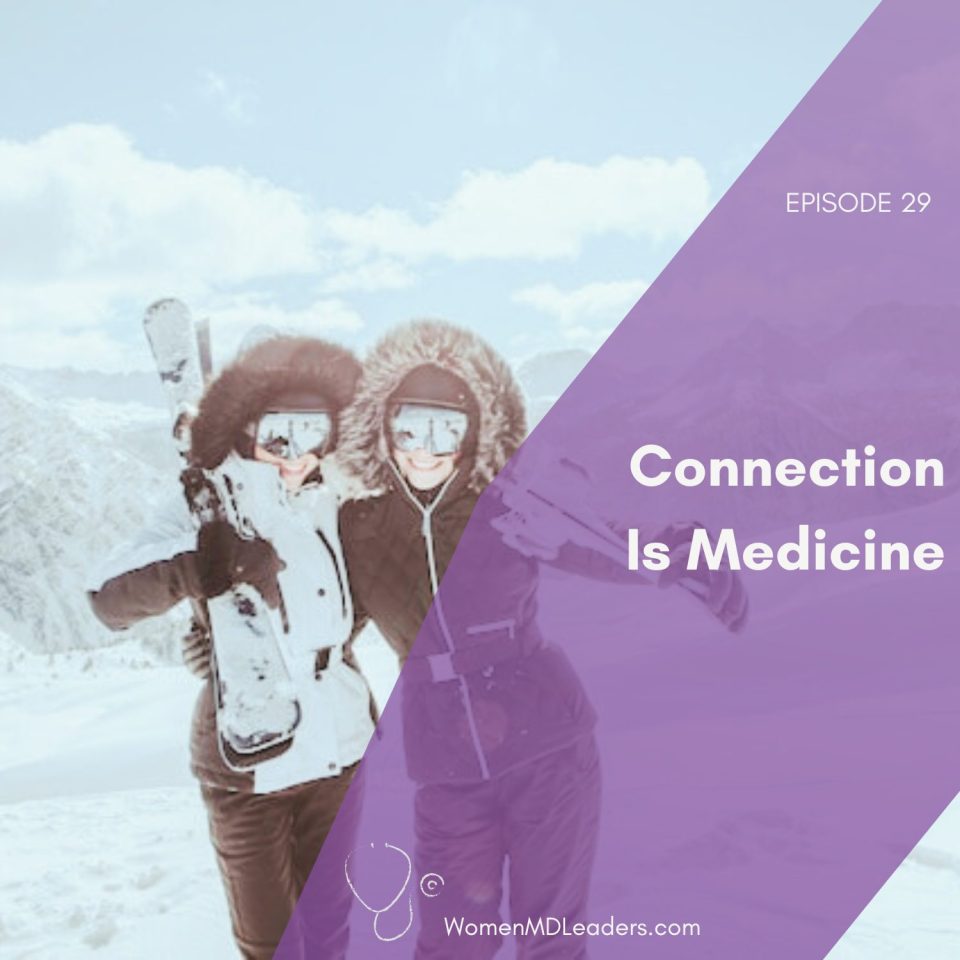
I felt that deeply on a recent ski trip I took. It was more than just skiing. I was reconnecting with old friends from California. I was skiing with women who love the sport as much as I do. We all left jobs and families behind to create space for ourselves.
It was rejuvenating. It was energizing. It was soul-filling.
Yes, I skied over 60 miles and 60,000 vertical feet — but what stayed with me most were the conversations, the laughter, the shared stories on the lifts and après ski.
It reminded me who I am outside of my roles.
Closing Segment
Connection doesn’t just make life more enjoyable. It is one of the most powerful forms of preventative care we have.
So if you’ve been treating connection like an afterthought… consider this your reminder.
Put it on the calendar. Protect it. Show up for it —
- even when guilt creeps in,
- even when you’re tired,
- even when it feels easier to cancel.
Because the version of you who feels supported, seen, and connected?
She leads, loves, and generally lives better.
And you — and everyone around you — deserve that version of you.
If this episode resonated with you — I’d love to stay connected with you beyond the podcast.
You can join my email community where I share reflections, tools, and encouragement specifically for women physician leaders who want to thrive — not just push through. Head to stpehanieyamout.com/join and sign up. It’s a space designed to support you, the woman behind the white coat and the leadership title.