
Have you ever walked away from a conversation thinking, Did that really just happen?
That was me — after an interview that revealed more about bias in medicine than any research article ever could.
Because when you’re the first woman in the room — or one of the few — the culture of that room is rarely built with you in mind.
It’s a culture shaped by the men who made it. And in medicine that is often one of hierarchy and authority — where confidence is measured in grey hair, and presence often looks like taking up space, not making space.
So we adapt.
We nod and smile trying to understand, soften our tone, hold onto our ideas until the “right time,” and work twice as hard to be heard.
It’s not just individual bias; it’s ingrained, unconscious and cultural.
And once you start noticing it, you can’t unsee it.
I want to be clear, this episode isn’t about blaming — it’s about naming.
Because when we all start naming bias for what it is and start talking about it, we stop normalizing it.
And when we stop normalizing it, we start changing the culture of medicine for good.
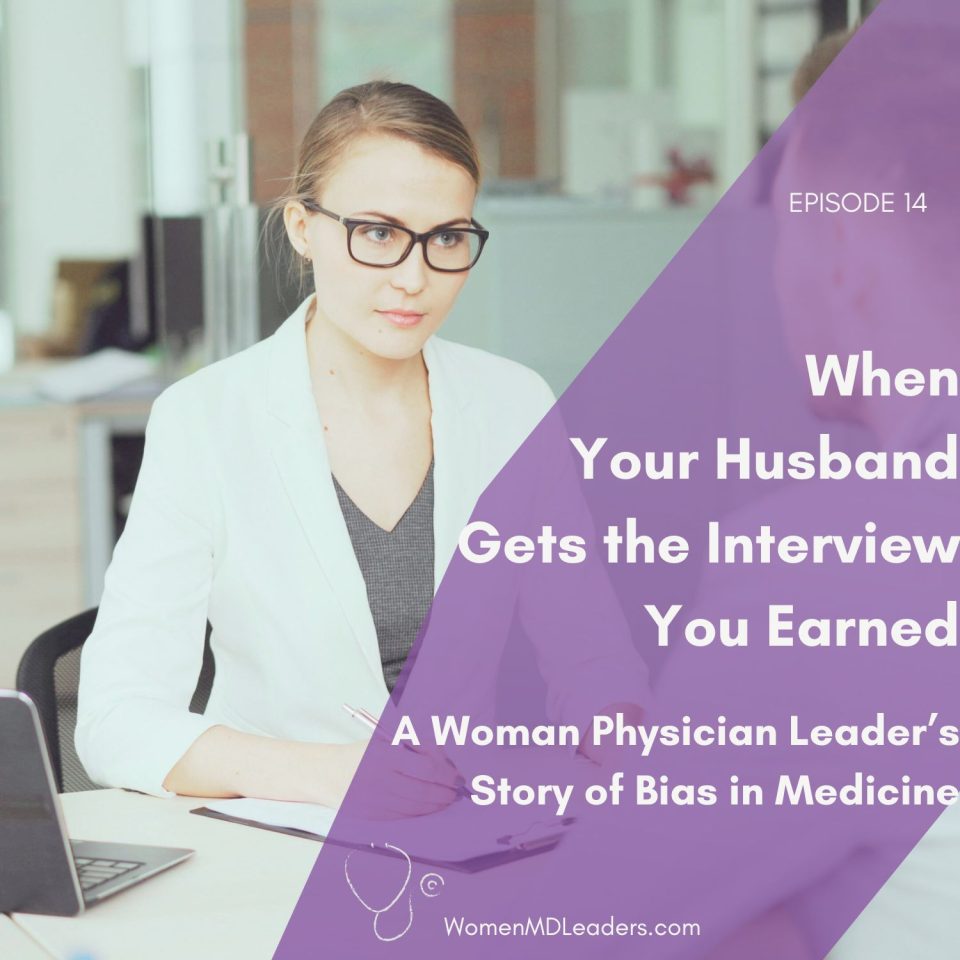
Blatant Bias – My Husband Stole My Interview
Bias shows up quietly, until one moment makes it impossible to ignore.
This particular interview stopped me in my tracks and kept me thinking about it for months afterward.
A colleague had referred me to what sounded like the perfect opportunity — a board position that aligned beautifully with my clinical experience and my background in hospital strategy and operations.
The company’s product was impressive: innovative, cost-saving, and truly capable of transforming care delivery if used wisely.
But then… the conversation took a turn.
When the founder discovered that my husband is a pediatric surgeon, the entire tone shifted.
Suddenly, he wasn’t interested in my decade of leadership experience, my strategic network, or my understanding of his target patient population.
Instead, he wanted to talk about my husband — how he might invest, and how his technical expertise could be useful.
He didn’t ask another single question about me.
And just when I thought maybe I was overreacting, the follow-up email arrived — doubling down. He wrote that he’d love to connect with my husband for “an additional interview” and included details about how we could invest.
He had no idea what that email revealed:
- His own bias,
- His own blind spots, and
- His lack of curiosity about what an experienced woman leader could bring to the table.
Is It My Job to Teach Him?
For months, I considered calling him back.
I wanted to tell him, “If you really want your company to succeed, you need women like me — not because of our connections, but because of our perspective.”
Women who understand systems, people, and the nuance it takes to bring an innovation into the real world.
But in the end, I didn’t.
Because I don’t believe it’s my job to fix his bias, his company, or his lack of vision.
And that realization brought me to something bigger — this wasn’t an isolated experience. It was just one of the more blatant examples of what women face every single day in medicine and leadership.
Unconscious Bias
Women in medicine are tired of this. Tired of ignoring bias that shows up daily — and tired of pretending it’s all in our heads.
Bias is so deeply baked into the culture that it feels normal.
Everyday, wrapped up in good intentions, we run into a strong pattern of unconscious bias.
For example:
When I was in high school, still just dreaming about becoming a doctor, a well-meaning physician mentor said to me, “Have you thought about how hard that will be when you have a family?”
He didn’t mean harm — but his question carried a quiet assumption about what success should look like for a woman. Like, why wasn’t it hard for him and his family? Thankfully, at that point, I ignored him and kept dreaming.
And then there was the school teacher who once asked, seeing me in scrubs, “Oh, are you a nurse?”
She meant it kindly — and later admitted she was embarrassed by her own assumption. Even women have bias about women in medicine. I think this encounter stayed with us both.
Bias in Medicine: The Everyday Moments
Then there’s the gaslighting. To be honest, I didn’t initially know what this word meant when it became popular, but now I get it. It’s just naming what we often experience.
Like, you finally speak up about something that feels off — a comment, an exclusion, a double standard — and you’re told, “You’re overreacting.”
No. You’re just reacting appropriately to something that should never have been normalized.
And the invisible work — the emotional labor women carry in hospitals every day.
A friend of mine, a medical director, jokes that she’s the “mom” of her department. She’s the one who listens, organizes, smooths things over, fills in the gaps, thinks of things before anyone else.
It’s all the behind the curtain work that keeps the team functioning, but it’s rarely recognized — or compensated.
These biases pile up.
They become the extra steps women have to climb just to reach the same height. We take 100 steps for every 30 our male counterparts climb.
And many of us do it while working 80% FTE so we can raise our families — meaning we’re paid less, yet still expected to show up at 100%.
Closing Reflection: The Breaking Point
So how long can one woman keep climbing like that?
How long before the resentment builds, before she stops carrying everyone else’s load and starts advocating for herself?
Because that’s what it truly takes to thrive.
Noticing, advocating, and bringing clarity.
We can’t fix every bias we encounter – nor should we feel that responsibility.
But we can name it, stop normalizing it, and stop carrying it quietly.
That’s where change begins.
Thank you so much for listening to this episode of the Women MD Leaders Podcast. Your support means so much to me.
If you have found this or any other episode to resonate with you, please take a quick moment to leave a rating or review. Or simply share the show with someone you know. I would be grateful.
That’s all for now. Take care. And protect your peace.