
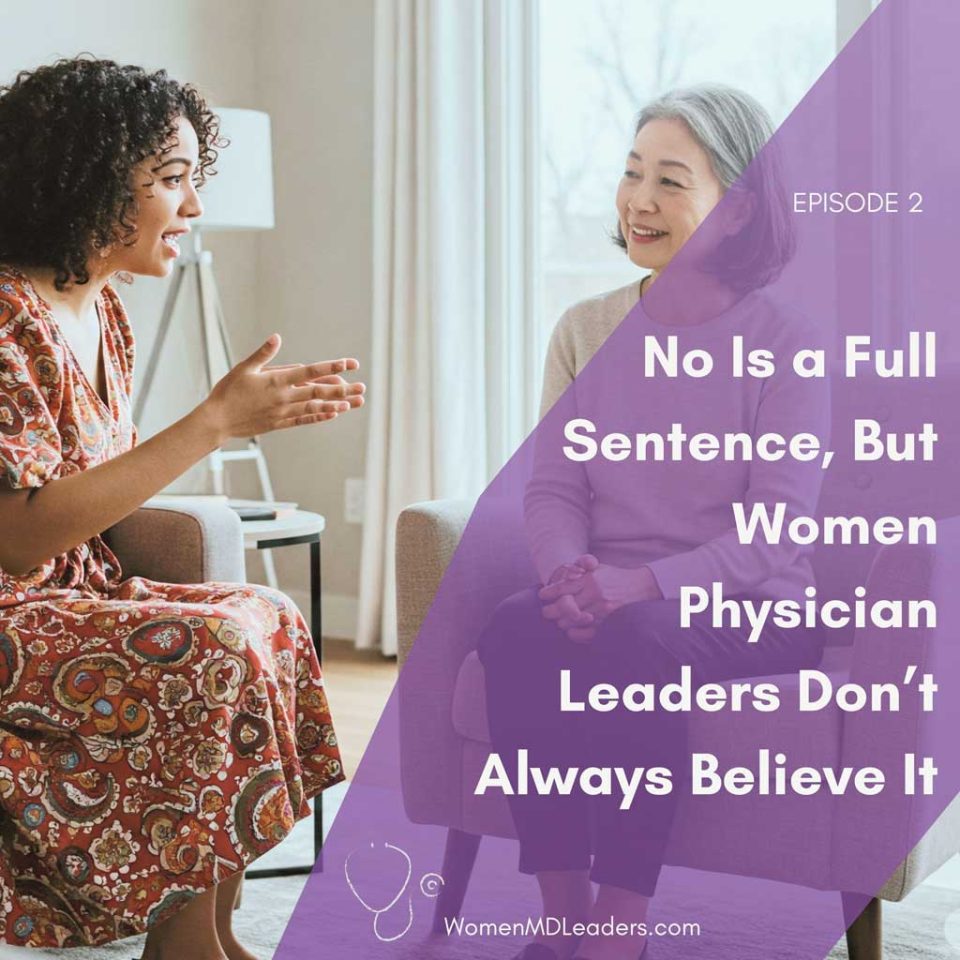
As women physician leaders, we’re used to saying “yes.” Sometimes we don’t even realize we’ve said it — it just slips out automatically. We’re so efficient at getting things done that we barely pause before diving in.
But those invisible yeses? They add up.
They accumulate over years — into jam-packed days, late nights filled with emails, PowerPoint slides, meeting prep, and workflow design. Each yes adds weight. And over time, that weight becomes exhausting.
Eventually, the load is too heavy. And we ask ourselves: How do I start saying no?
Where do I even begin?
Some physicians flip the switch and take a sabbatical — and let’s be honest, that sounds pretty tempting. Others step back from roles to reclaim space.
And some get clear on their values, saying “yes” only when it truly aligns — protecting their limited time and energy for what matters most.
It’s not always easy, but it’s a powerful shift. And it changes everything.
Let me tell you a not-so-funny story about me, some messy adulting, and learning how to set boundaries.
I once had a dog walker who caused me more emotional turmoil than trying to get pre-auth and scheduling a sedated MRI. Seriously. I hired her to save me time — you know, so I could focus on important things like work, life, and occasionally remembering to eat lunch.
But instead, I found myself spending more time thinking about her than she actually spent walking my dog.
At first, it was little things. Unreturned texts. Schedule mix-ups. The occasional “I decided to take your dog for a three-hour spiritual journey instead of a 30-minute walk.”
And yet, I ignored it. I told myself, “She’s a local entrepreneur! She loves dogs! She’s doing her best!” Meanwhile, I was white-knuckling my calendar trying to accommodate her chaos.
Eventually, I hit an emotional wall. One day, I realized I was spending more brain space managing her than I was managing my actual job.
I had a dog walker who was supposed to save me time — and instead, she had become a part-time emotional job.
But could I just fire her?
Oh no. Instead, I tortured myself with the world’s most overthought breakup scenario. I spent months drafting imaginary conversations in my head, revising the script every time she texted something weirdly passive-aggressive.
I worried about how she’d take it, if she’d think I was cruel, if she’d have enough business, and whether I was personally responsible for her entrepreneurial dreams. (Spoiler alert: I wasn’t.)
The Biggest Lesson for Leaders
Looking back, the minute I realized the relationship wasn’t serving me — not aligned with my values, not saving me time, not giving me peace — I should have let it go. My goal was to reclaim time, not trade my physical energy for emotional labor.
And the biggest lesson?
I spent so much energy worrying about how she would feel about my boundary. Meanwhile, none of that was actually in my control. Her feelings, her reaction, her situation? All hers to handle. My decision to carry all that emotional weight? That was on me.
And that’s where I needed to shift.
In the end, I didn’t need a master plan, or a script, or a guilt-trip roundtable. I just needed one honest, clear conversation. I needed to say: “This isn’t working for me anymore.” That’s it. That’s the sentence. That’s the boundary.
If it’s not working for you, it’s working against you.
And that, my friends, is how I learned to fire a dog walker — and reclaim my emotional sanity.
Now, I’ll admit — I didn’t just magically grow a backbone overnight.
I read multiple books on boundaries. I binged podcasts. I basically earned an honorary degree in How to Say No Nicely.
And still, I spent months spiraling over one dog walker. But once I finally had the conversation and let her go, I felt this huge weight lift off my chest. Like, Ohhh — this is what it feels like to have space in my brain again.
That clarity? It was addictive. I started noticing everywhere in my life where boundaries were getting trampled — at work, at home, with extended family, with friends.
Practice Setting Boundaries in Smaller Spaces
The more I practiced just saying the thing, the freer I felt.
It turns out, life doesn’t have to be a constant game of emotional Tetris. It really can be simpler when we’re clear about what we need and we say it out loud.
I finally stopped saying ‘yes’ to every volunteer opportunity at my kids’ school. No more Amazon Prime frenzied ordering at midnight to host the next school party.
I also stopped tossing my name in the ring for every new leadership role that someone kindly suggested I’d be ‘perfect’ for. I realized I only wanted to focus on roles that I wanted to fulfill, not roles that the organization thought I would be great for.
And let’s not forget the work meetings where someone says, “We just need someone to take this on,” and everyone awkwardly remains silent on that team call while I, the over-functioning people pleaser, say, “I can do it.”
Yeah. Not anymore.
Because here’s the truth: just because I can do it — and let’s be honest, I can probably do it really well — doesn’t mean I should be the one to do it. Every. Damn. Time.
Boundaries, my friends. They’re not walls — they’re fences with gates that I get to open and close. And let me tell you, the view from inside the fence? Way more peaceful.
You don’t need to explain.
And one last thing — when I finally fired that dog walker, I didn’t list out all the reasons. I didn’t make excuses. I didn’t explain what was next for me or my dog. It was crisp, clear, and to the point.
And let me tell you — it had to be, because I was sweating through that entire conversation. But here’s the truth: no one is entitled to the why behind your decision. Your choices are your own. Period.
This is where the people-pleaser in me still flinches. I want to explain, to soften the blow, to make sure the other person feels okay. But the truth is — that’s not my job.
I can’t control someone else’s thoughts or feelings. None of us can. And spending our time trying to? That’s just energy we don’t get back.
We’ve got far better things to put our energy into. Like the Code 3 in the ED or the Joint Commission Survey who just arrived unannounced.
And you know what?
- When I stepped back from volunteering at school, the party still happened.
- When I didn’t apply for that next leadership role, I stayed fulfilled where I was — and when the right opportunity showed up, I had the energy and clarity to say yes with my whole heart.
- When I didn’t jump in to take on that extra project in the meeting? It got assigned to someone else — someone it actually made sense for. And the work got done.
Imagine that.
Now, I’m not perfect at this. Not even close. I still practice all the time. I’m even teaching my 12-year-old how to set simple, clear boundaries — because it’s never too early to learn how to protect your peace.
But once I got the hang of it, I finally felt like I had a grip on my calendar again. I started to reclaim my time, my focus, my sanity.
And when you work in a field where chaos and emergencies are part of the job — where your time is often not your own — having boundaries where you can? That’s power. That’s peace. That’s freedom.
Until next time — take care of your time, and protect your peace.