
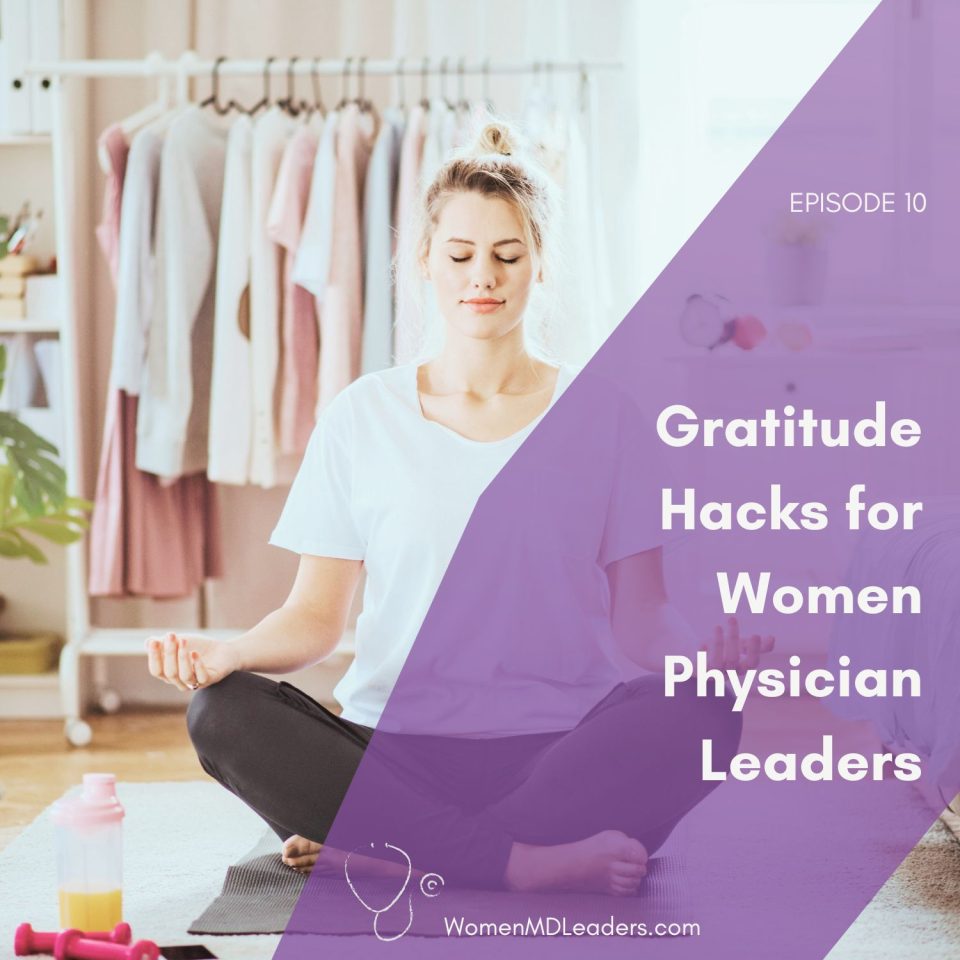
Do you ever find yourself “working” before work just so you can have a smoother day? Because, once the “real” workday hits, it’s nonstop.
- Patients.
- Students and residents.
- Meetings.
- Emails.
- Fires to put out.
- People just asking you for things.
It’s easy to feel like I’m sprinting from start to finish without ever taking a moment to pause.
For so many reasons, women physicians tend to jam pack their days from sun up until they finally hit the pillow at night.
It’s a habit deeply ingrained in us.
Then we step into leadership, often without formal training… and if we do receive leadership training, the focus rarely lands on this one pivotal thing:
Caring for ourselves directly improves the way we lead.
The truth is, leadership is not just about what we give to others, it’s also about how we sustain ourselves.
One of the simplest ways to do that is through gratitude.
Not the big, performative kind… but quiet, intentional moments that take seconds, yet can shift the tone of an entire day.
Gratitude to Lighten the Weight of Exhaustion
Gratitude has been scientifically shown to improve mood, protect against burnout, and even strengthen the immune system.
And in the middle of the chaos of medicine, it can be a lifeline — a way to anchor ourselves in joy without adding to our already packed schedules.
The need for that anchor is real.
Right now, the weight on physicians feels heavier than ever — being asked to see sicker patients, move faster, navigate lower reimbursements, and practice under the constant shadow of legal risk.
And in the middle of it all, it’s easy to feel unseen — especially when the people we care for may never realize the countless hours, sleepless nights, and personal sacrifices we’ve made for their health.
As physicians, and especially as women in leadership, we can’t pour from an empty cup. Just like on the airplane, we have to put on our own oxygen mask first.
That means giving ourselves permission to slow down, even in a system that pushes us to go faster.
Put yourself first even in a profession based solely on caring for others.
Gratitude is the Building Block I Needed in Hindsight
Being grateful not a habit I have always had.
To be honest, when I was praying just to get accepted into medical school, and later praying I’d match into a residency I liked, all I wanted was to be wanted. Anywhere. So I could become a doctor.
That longing felt so consuming that it didn’t seem reasonable to ask for anything else, not even from myself.
I certainly did not have the practice then of being able to look around me and appreciate all of the goodness the world has brought me. It was such a singularly focused time in my life.
This level of singular focus, over the course of a lifetime, is a fuse for burnout. Clearly.
I only wish I had taken a moment to remove my blinders and see the bigger world around me during those phases of my life.
Gratitude has a way of pulling you back to center — it shifts your gaze from what you’re chasing to what you already hold.
It softens the drive to constantly prove yourself and instead helps you live from a place of grounded presence. It helps you to live more authentically and in the moment.
In hindsight, I can see that gratitude would not have lessened my ambition. It would have steadied it.
Gratitude would have reminded me that my worth wasn’t hanging on the next acceptance letter or match result, but was already present in who I was becoming.
That’s the quiet power of gratitude: it doesn’t change your ambition, but it transforms how you carry it.
Practicing Gratitude for Women Physician Leaders
Reclaiming energy through gratitude can be as simple as noticing the bright side — especially when everything feels grey.
This came up recently with a client.
She was in conversation with a colleague who happens to be extremely wealthy — different lifestyle, different financial bracket entirely. And she found herself shrinking in that moment, feeling inadequate.
I see this all the time in my online physician social groups.
People comparing salaries, lifestyles, vacation homes… or just their ability to afford childcare in some parts of this country. It’s disheartening, especially for physicians who pour everything into their patients only to see measly raises year after year.
The frustration is real. The feeling of being undervalued is real.
But here’s the thing — comparison never shows the full picture.
And while we can’t ignore the systemic issues at play, we also can’t let someone else’s highlight reel steal our sense of worth. They say, “comparison is the thief of joy.”
Sometimes, the practice is simply to pause and ask:
- What’s true for me right now?
- What is working?
- What would I see if I looked for even one bright spot today?
Bring Gratitude Home
Now, I practice this at home too.
Take my son, for example. He’s privileged enough to attend summer camp. He’s learning to sail — something many kids never get the chance to try. But he’ll still come home and say, “It was so hot,” or “It rained all morning.”
Totally valid complaints. And yet, when I gently ask him to name three good things from his day — just three — he pauses.
Then he lights up:
“There were dolphins swimming next to my boat.”
“We sailed to a beach to have our snacks.”
The moment shifts. So does the energy.
Not because we ignore the discomfort — but because we remember there’s more to the story.
Small Habits Play a Role in the Greater Leadership Landscape
This practice doesn’t erase exhaustion or solve burnout on its own. And some days, it’s nearly impossible to muster.
By creating a daily gratitude habit, the lens you see the world through begins to change.
Little by little, it becomes more natural. The days don’t feel quite as grey. Bright spots start to stand out — moments of hope and optimism appearing where slouched over exhaustion used to linger.
And when you’re completely spent, when the day feels like it ran you over instead of the other way around—this little shift matters.
It creates momentum. It opens a door.
And over time, it helps you reorient your brain toward what fuels you instead of what drains you.
Think of gratitude like compound interest for your health — the more you practice, the more it pays off.
Over the years, it can calm your stress, help you sleep deeper, keep your heart stronger, and even boost your immune health.
Gratitude is one of those small, simple habits that ever so quietly changes everything.
Simple Ways to Practice Gratitude
There are lots of ways to weave gratitude into your life, but here are three that are simple, doable, and actually kind of fun:
- Journal
The trick here is to keep it simple. Put a notebook and pen right next to your bed so it’s always within reach. Make it the first thing you do when you wake up — before you check those damn emails — or the last thing you do before your head hits the pillow. It doesn’t have to be perfect or poetic. Just jot down where joy showed up for you that day.
- Meditate
Now, I’ll be honest — I’m not exactly a meditation master. But I’ve learned a lot about the benefits from using the Calm app. This one can take a little more time, so try setting aside a few quiet minutes. Maybe in the parking garage before you walk into work… or before you walk into your house. Just sit in silence, breathe, and reflect on the bright spots.
- Match a Moment
Pick something you do every single day and turn it into a gratitude cue. For me, when I worked in the NICU, it was my two-minute scrub before going in. I’d use that time to think about one thing I was grateful for.
Your “moment” could be brushing your teeth, waiting for your coffee to brew, or walking the dog.
And don’t forget to reward yourself. If you set a gratitude goal and hit it – treat yourself. You’ve earned it. And who knows? This just might become one of those rare habits that truly sticks.
When you practice gratitude, you don’t just care for others better — you care for yourself better, too. And that’s where authentic leadership begins.
If you’ve enjoyed this episode, please take a moment to rate, review, and share it. It would mean so much to me. And if you’re interested in learning more about working with me, please visit me at WomenMDLeaders.com/work-with-stephanie to find out more.
Until next time. Take care and protect your peace.