
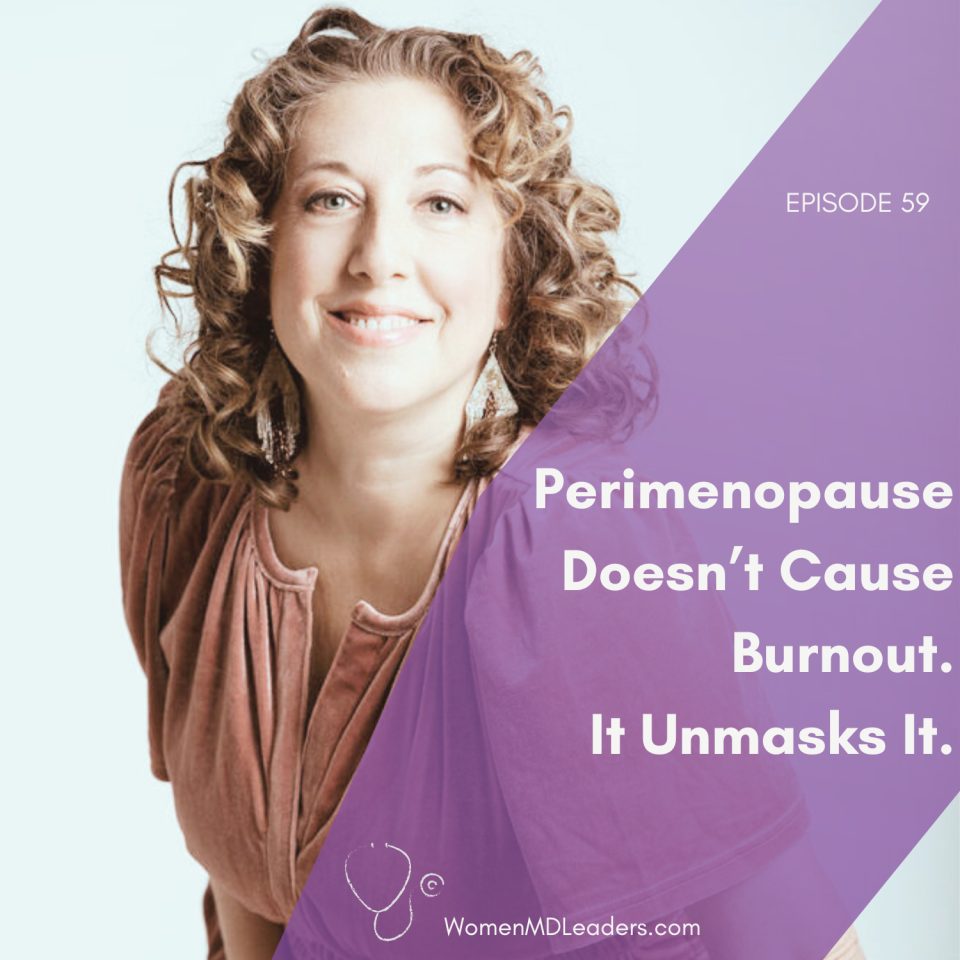
DR. STEPHANIE YAMOUT: All right, here we go. Today we are going to talk about burnout, but not the version that looks like total collapse. We’re going to talk about the high-functioning version — the one that still sees patients, still leads the meeting, still answers the email messages, remembers the camp forms, the snacks, the dentist appointments, and the birthday parties. This version that looks successful from the outside but feels unsustainable on the inside.
And we’re also going to talk about what happens when burnout collides with midlife: perimenopause, sleep disruption, identity shifts, and the nervous system of a woman who’s been holding it all together for a very long time. My guest today is Dr. Zarya Rubin, a neurologist, functional medicine physician, burnout expert, and international speaker who helps high-achieving women understand what their bodies have been trying to tell them.
Dr. Zarya, thank you so much for being here today. It’s exciting to have this conversation with you.
DR. ZARYA: Well, thank you for having me. It’s such a pleasure to join you on your podcast.
DR. STEPHANIE YAMOUT: I’m going to jump right into the first important question. For the woman physician listening between clinic, committee meetings, patient care, kid logistics, and a full inbox — how does she know that this is burnout and not just another hard season?
DR. ZARYA: I think that’s a really great question. I think most people who are burned out, if you asked them if they were burned out, they would say absolutely not. I would have said that. I didn’t know when I was burned out. Now, of course, that was a while ago, and it wasn’t as popular or as socially acceptable a term. It hadn’t really come into mainstream media, and there wasn’t as much awareness. This was back in 2007.
But nowadays there is a lot more awareness and publicity, and that’s a good thing. You read about it in social media and in the news — there have been a lot of news articles lately, especially about women in medicine. And I think the tendency is to assume that this is just sort of what adulting feels like. This is just how it is. This is what I signed up for, right? Life is hard, medicine is hard, I’ll sleep when I’m dead — that kind of thing. And a lot of people actually say that.
But there are certain telltale signs and symptoms. There’s a clinical definition of burnout, and it really has three pillars or hallmarks.
The first one is exhaustion. And it’s not just “I’m tired” or “I was on call, I’ll get some extra sleep this weekend and I’ll be fine.” It’s really a bone tiredness. It’s a sense of I don’t think I can get out of bed in the morning. It’s a struggle to put one foot in front of the other. You sort of feel like you’re walking through quicksand, and it’s nearly impossible to keep going.
The second pillar is cynicism, which is a little harder to characterize, but it’s pretty common in medicine. We see it when people have this gallows humor about everything — really cynical jokes about work, about patients, about life. It’s a coping mechanism, but it’s also a warning signal. You’ve maybe lost hope, lost trust in the organization you work for. Maybe you’re out of alignment with the values of the system. We see this all the time in medicine, especially in the case of something we call moral injury — which is really common among doctors, where you know what you have to do, what you should do, what the right thing to do is to deliver the kind of patient care you want to deliver, and yet there are all these obstacles preventing you from doing that. Time, insurance, barriers, lack of resources, the constraint of being forced to see too many patients. That creates a real burden on physicians. That’s moral injury. And that can lead to something called compassion fatigue, where we’re literally not able to have the compassion for the people we’re supposed to be taking care of, because we’re so beyond taxed and the system has extracted everything from us. We’re quite possibly exposed to repeated trauma day in, day out at work that hasn’t been addressed or managed. So you end up with cynicism, compassion fatigue, and moral injury all wrapped together.
The third piece is decreased professional efficacy, or productivity. You feel like you’re not really able to do the things you used to do as well as you used to do them. You lack focus, you’re irritable. Now, this may not show up in actual performance, because we’re all super high achievers and perfectionists. So from the outside it might look like you’re managing, but you’re sort of quiet quitting, phoning it in. You might have a lot of doubt and insecurity about what you’re doing, and you notice, this is not to my standard.
So those are the three classical pillars and clinical descriptors of burnout. Now, I’d say the other one that’s kind of a sneaky telltale sign is if you start having fantasies about getting into a car accident, becoming ill, going to prison. These are all things I’ve heard from people. That’s a huge red flag that something really has to shift. It is quite common. It’s not normal, and you shouldn’t really be feeling that way. If your job and your life have become so unbearable that you’re dreaming about getting hit by a bus, that’s a problem.
DR. STEPHANIE YAMOUT: So much of what you just said hits home for me. I never dreamt about getting hit by a bus, or technically going to jail or anything, but I very specifically remember looking out the window and thinking, I just want to scrap all of this and, like a college student, go home to my mom’s and lay on her couch and forget everything.
DR. ZARYA: Yeah. I used to think about being stranded on a desert island or something. That would be great. No pagers there.
DR. STEPHANIE YAMOUT: Yeah. No one can ask you for anything. There’s no pressure. There’s no internet.
When you were talking about the second pillar — the cynicism and the moral injury — I was reflecting on how that pillar shows up in a lot of my clients, and also for me, as resentment. And it started popping up in many different areas of my life, not just one. When does that become a red flag for someone?
DR. ZARYA: Sure. It can be directed toward your partner, toward your kids. Literally anyone asking anything of you becomes too much, and you start snapping at people you love and becoming more isolated and more distant. I think that’s another telltale sign — isolating from friends and family. There’s a lot of shame associated with burnout, and people don’t want to tell anyone. They don’t want to admit there’s a problem. They believe everybody else is just fine, where they may not be, but they’re so worried about revealing that people are going to think, I’m a failure, why am I not good enough, why am I not strong enough, what’s wrong with me that I can’t be like everybody else. So you keep to yourself.
DR. STEPHANIE YAMOUT: No, a hundred percent. In medicine, what I’ve found is that burnout becomes kind of a catch-all phrase. When you’re working with clients or speaking, how do you separate burnout from moral injury, and symptoms of depression, anxiety, trauma, or even chronic stress physiology?
DR. ZARYA: I don’t know that you can. I think it’s all intertwined. It’s all wrapped up together, like an intersecting Venn diagram. You put all of these pieces together and you have burnout. Burnout is sort of the end result of chronic stress, moral injury, and a nervous system that’s been stuck in survival mode for probably a very long time — in many cases, dating back to childhood. We now know that childhood trauma and things like ACE scores really do have an influence on burnout down the road, and increase your burnout risk several-fold.
I actually gave a talk about burnout this past weekend with a different focus — on kids and childhood — because we sort of believe that burnout starts in the corner office, or on the night shift in the ER in your forties. But I think it really starts decades earlier, and we have to learn to recognize it and start addressing those dynamics and mechanisms much, much earlier.
DR. STEPHANIE YAMOUT: You have your own burnout story. Can you take us back to a moment where you realized this is just not sustainable anymore?
DR. ZARYA: Yeah, I can see that moment really clearly. Actually, the anniversary of that moment was twenty years ago yesterday. Ironically.
So, I was at the end of my medical training. I was completing my fellowship at a very prestigious program at Columbia University in New York. I had gone all the way through four years of pre-med, four years of med school, a five-year residency, and I was finishing up a two-year fellowship. I waited until the very end to decide this was not working. I really pushed my way through, and there were red flags and warning signs all the way through, but I chose to ignore every single one of them. I had blinders on. I think my drive and determination — which can actually be tied up in trauma and burnout — was so strong that it overcame all of those glaring, obvious things telling me this was not the right path. But that was my childhood dream, to be a physician, and I was going to keep going and going, like the Energizer Bunny.
Medicine is such a prescribed path. It’s laid out before you — this step, and this step, and this carrot dangling at the end. You just have to keep going, keep achieving, and eventually you’ll get to nirvana, which is you become an attending, you’re super happy, and you finally start earning a salary. But at that point, you’ve sunk so much into it. It was sort of the sunk cost fallacy — well, I can’t possibly leave now, I’ve invested so much.
So I was at the end of my fellowship, living in New York City, and I was absolutely miserable. I had all of the signs. I could barely get out of bed in the morning. I would stand on the subway platform waiting for the train to go to work, and the train would be coming, and I would look at it and think, gee, I don’t know, should I get on it or jump in front of it? And that was kind of a joke I made to myself every day. I didn’t realize the gravity of that sentiment — that this is not normal, you should not be toying with suicide every day as a way out of this. But I did. I kept going.
It really took a massive wake-up call, which was literally a phone call from my best friend from medical school, late one night. She was calling to tell me that her husband had collapsed while playing frisbee. They had tried to resuscitate him and rushed him to the hospital, and I said, well, but he’s okay, right? And she said, no, he didn’t make it.
I think I dropped the phone at that point. That shock and grief, and that flash of my own mortality, just shifted something in me. Something broke, and I thought, I don’t — if this is all there is, and he was really young, he was thirty-five — I don’t think I can keep living my life like this if this is it. That’s what started the process of really coming to the painful realization that I had to leave medicine, and I had to somehow extricate myself from twenty years of training and the identity piece and all of that. Because it really is more than a job or a career. It is literally who you are. It’s your entire identity, and I didn’t know who I was outside of being a doctor.
But what stuck with me was this Turkish proverb, of all things: No matter how far you’ve gone down the wrong road, turn back. And that’s what gave me the permission to walk away from something I had invested decades and hundreds of thousands of dollars into.
DR. STEPHANIE YAMOUT: In business there’s a term for this — sunk cost. This is your starting point from here.
DR. ZARYA: Sunk cost, exactly. It’s a fallacy of, well, I’ve invested so much, so I have to keep going. But you’ll never get that lost investment back. If you keep throwing money into a money pit, you have a chance to save yourself by cutting your losses — but it’s very hard psychologically to wrap our minds around that.
DR. STEPHANIE YAMOUT: I’m really curious about this identity shift, because that’s something we go through every day sometimes as doctors — between being a mom and a doctor, a doctor and a partner. We shift back and forth all the time. I didn’t have that mom identity yet when I was a resident. When did you have your children?
DR. ZARYA: Much later.
DR. STEPHANIE YAMOUT: Shifting out of an identity that’s been your whole life, your whole training, your whole drive, into a new identity — even if you’re staying in medicine versus leaving — there has to be some kind of a shift for you to not keep thinking about jumping in front of the bus. Do you have insight into the steps it took to shift?
DR. ZARYA: It definitely took a massive wake-up call. I wish it didn’t. I was on another podcast once, interviewing somebody, and we were talking about the idea that maybe there doesn’t have to be a big aha moment, maybe you don’t have to hit rock bottom to get out of a situation. And I thought, gosh, I wish that were true. But human beings are so stubborn and persistent that I don’t know that it is. I’ve never encountered someone — a client, a friend, someone I’ve interviewed — who said, I was starting to feel a little burned out, and I stepped in and turned things around. It’s always, I was at the end of my rope. I had physical consequences, psychological consequences. My marriage was hanging by a thread. I was hospitalized. I interviewed someone who was airlifted to a hospital because she had a ruptured gastric ulcer. Sometimes it really takes these huge warning signs. I wish it didn’t.
In terms of the identity shift, there has to be a lot of self-compassion. If you don’t have that self-compassion piece, you’re just going to be beating yourself up about what you’re not doing, what you’re not achieving, how you’ve “failed.” We really have to treat ourselves with a lot of care and a lot of reverence and support, because if we don’t support ourselves and give ourselves that self-compassion, we’re not going to heal from this, and we’re not going to be able to move forward and craft a new identity. People say, my gosh, what’s it like to not be a doctor anymore? And I say, well, I’m always going to be a doctor. I’m just not currently practicing clinical medicine. I didn’t go to medical school and devote those decades of my life for that to just be erased. It’s part of who I am. It’s part of my story.
But I think that’s also part of it — we’re complex, we have multifaceted identities, and we’re allowed to have multiple parts. Medicine really dictates that you’re not. You can really only be a doctor, and you have to sacrifice everything else at the altar of medicine and service. I thought, well, if I just sacrifice everything, surely I’m going to be happy, right? Because I just keep giving and doing. Isn’t that the secret to happiness? Spoiler alert — it’s not.
DR. STEPHANIE YAMOUT: Right. We’re rewarded for believing that. And there’s that stretch we all go through — get into school, get into residency, get into fellowship — this single-minded focus that doesn’t allow room for that complexity.
DR. ZARYA: You go so far down that path, you have tunnel vision. It’s almost like a moving sidewalk, or an escalator. It’s dragging you along, going forward, and it’s very hard to get off.
DR. STEPHANIE YAMOUT: It doesn’t allow for flexibility. And then when you do allow yourself that self-compassion, it feels a little selfish, a little guilty. That’s what I’m commonly seeing.
DR. ZARYA: Yes. It’s the oxygen mask principle. On an airplane, we’re taught to put our own oxygen mask on first before helping others, but we don’t do that.
DR. STEPHANIE YAMOUT: No. For so much of it, there hasn’t been room to do that. Personally, I didn’t make room to put my own oxygen mask on until I hit forty — until I hit an age where you get to say whatever you want, you have a right to say it. I suddenly had a right to let these complexities into my life.
You and I had talked a little before this interview about that crossroads of burnout during perimenopause — what changes in this season of life that makes us see it, or experience it, differently?
DR. ZARYA: In perimenopause, it’s a confluence of our life experience, what’s happening interpersonally and professionally, but it’s also literally biological and physiological. There’s a shift and a transformation happening. We’re moving away from a system that ran on estrogen and progesterone. When we had those hormones circulating freely and abundantly, there was a lot more buffer zone. Estrogen upregulates all the feel-good hormones — serotonin, oxytocin — and it dampens down some of the negative feelings, the anxiety, in the amygdala. Then there’s the whole HPA axis — hypothalamic-pituitary-adrenal axis — and estrogen functions as a buffer and a cushion. It makes that system more responsive. It’s an intricate feedback loop; it responds faster and it buffers stress. When that starts to go away, you feel stress more intensely, you react to smaller things in a bigger way, there’s less buffer, and the system is stuck more in the “on” position — it doesn’t shut off. And then there’s progesterone at play too. People think perimenopause is just estrogen, but progesterone acts on GABA receptors, and it also lowers ACTH and cortisol and decreases HPA activation.
So you’ve got this situation where life is stressful — you’ve got work, you’ve got kids, maybe you’re reaching a point in your career where you’re getting promoted, you’ve got the sandwich generation phenomenon with aging parents and kids at the same time — and then your hormones just say, sorry, we’re going to make stress your best friend, and you’re going to be deep in it and not able to get out. So perimenopause doesn’t exactly cause burnout, but it sure as heck unmasks it. You’re no longer able to maintain an unsustainable situation. All the things you did when you were younger — drinking, staying up late, overwork — it just stops working.
DR. STEPHANIE YAMOUT: All of that rings so true for me. I’ll add to it — as physicians, many of us had our children a little later because we were so busy studying. So we’re now in perimenopause with heightened stress hormones, and we have kids going through puberty at the same time. Talk about a sandwich.
DR. ZARYA: A hundred percent. And we didn’t even talk about the more common effects of estrogen and progesterone depletion and fluctuation — poor sleep, mood issues, brain fog. All of those things contribute to that soup of burnout. If you’re not sleeping, and you’re in this fog, and you can’t concentrate at work, you can’t think — you think, my gosh, I’m not functioning at the level I’m supposed to, I’m not performing the way I used to. That creates a lot of panic, anxiety, imposter syndrome. It’s a feed-forward system at that point.
DR. STEPHANIE YAMOUT: They’re building on each other. And the red flags you brought up stay the same, but the treatment is different. I’ve personally found that having a healthcare provider who can actually holistically treat you during perimenopause is so incredibly valuable. I’ve run into both — I’ve been completely dismissed. “Are you having hot flashes?” “Well, no, not quite, but I can’t remember words.”
DR. ZARYA: Oh my god. If I had a dollar for every time it’s, “you’re not having hot flashes, so you’re not in perimenopause” — that is such BS.
DR. STEPHANIE YAMOUT: And it’s so frustrating to hear as a woman who’s a doctor, who’s clearly knowledgeable and has done research into her own body and symptoms.
DR. ZARYA: I’m in my fifties, I still sleep with a heating pad. Everybody’s different. You have to personalize and individualize it, and listen to women, believe women. There’s a whole laundry list of signs and symptoms of perimenopause. Thank God we’re raising awareness through social media and through experts speaking out. I think Gen X women really led the way — we’re not taking this quietly and lying down, we’re going to talk about it, raise awareness, we’re not going to be embarrassed, we’re not going to hide in a corner. This sucks, and there’s no information, and women are not being listened to, heard, treated adequately. HRT is being gatekept. And also — hey people, check your thyroid.
DR. STEPHANIE YAMOUT: A hundred percent. What I see in a lot of my clients — women physicians who hit this midlife period, and this relates a lot to me too — is they come to this realization that they built this career they always dreamed of, and now there’s this sense of, I don’t think I can keep living this way. What do you think is really happening for those women?
DR. ZARYA: I think they’re shifting out of a mode where they were living more of a performative life for others — having to be the good girl, the perfectionist, the overachiever, the healer, the eldest daughter, the caretaker figure — and doing everything on an outward level, for others, for society, and all the rewards we got from that. And at a certain point you sort of wake up to, but what am I doing for myself? Who even am I? Because I have not allowed myself the space, the time, the permission to explore that.
Who am I really? What do I really want? Do I really enjoy this? Medicine has become a really challenging career in terms of its structure — the punishing hours, the lack of pay equity, the insurance system, the fee-for-service system — all of these things that really tax physicians. It’s not really what I signed up for. I signed up to care for patients and help people, but it’s basically charting after hours, I can’t keep up with all the paperwork, all this stuff that’s not fueling me or lighting me up. It’s draining.
DR. STEPHANIE YAMOUT: There are so many systemic factors that weigh on us. I remember applying for medical school and being told, you need to go volunteer, you need to shadow, you need to learn. I shadowed, and I really enjoyed those experiences — but none of that prepares you. None of that is a true vision of what the day-to-day life is, or what that day-to-day is on top of the second job you have when you go home — the COO of your whole household. You can’t really know what that experience is like until you get there.
DR. ZARYA: I worked in a clinic for a year before medical school, and it was all men physicians. They all told me medicine sucked and I shouldn’t apply. They said, in your interview, just — you’ll be fine, but don’t say you want to save the world or anything like that. And I thought, but that is what I want to do. And you’re so young and so naive, you think, my gosh, they’re so wrong, they’re so cynical, I’m going to be different, I’m not like that. I shouldn’t listen to these guys. But they were all men, and they all had wives at home who did everything for them.
DR. STEPHANIE YAMOUT: I’ve always said I need a stay-at-home mom too — someone to stay home and manage everything. What I realize now is if I went back full-time the way I was before, I would totally spend the money on a household manager who could manage all the school emails, the groceries, the dinner — all the things a stay-at-home spouse would do. It felt like such a glorious expense at the time that I never would have done it. But that’s really how you survive in medicine — you have someone take care of the second shift, so your emotional load becomes manageable.
DR. ZARYA: People really underestimate that invisible mental load mothers carry. It doesn’t matter if you’re the primary breadwinner or not, it still falls to women — I don’t really understand why — and that invisible, unpaid labor takes a toll. It’s a whole other job. I saw a tweet the other day: the mom says, do you know when our daughter’s band concert is? The husband says, no, when is it? And the wife says, exactly.
DR. STEPHANIE YAMOUT: Unless you hand off the whole thing — planning and execution — you’re still carrying part of the story.
When you carry the executive function of your whole house — again, I should have hired a household manager, had I understood — one of the things I find, in my clients and in myself, is that perfectionists and people-pleasers and over-functioners carry a lot of guilt. Even though as adults and physicians we know we need sleep, space, movement, boundaries — doing these things, like taking an hour to go to the gym at 5pm and not getting home until six, brings up this feeling of, where should I be? All the shoulds of life. What do you, as an expert in burnout, say to a woman who feels this way — who feels like she has so many people relying on her, she needs to be there, she should be there?
DR. ZARYA: I think it’s a bit of a self-fulfilling prophecy, a trap we get ourselves into — we think we’re more indispensable than we are. And choosing yourself, setting boundaries, is a muscle. It’s a practice most of us are not well practiced in at all. When I encounter that in a client — “I can’t,” “I couldn’t possibly,” “there’s no time” — I say, but what if there was? What if you tried it just once? Could you set aside one hour? “No, I couldn’t.” And then they do it. Let’s just do an experiment — set aside this one hour, do this one thing for yourself, one time. And they do it, and they think, my god, the world didn’t come to an end. The sky didn’t fall. My husband took care of the kids — okay, their clothes were on backwards, they ate junk food, it’s fine, everyone survived.
And then it builds that muscle. They notice they have a little bit of extra breathing room, a little more spring in their step, the ability to return to the charting and the dishes and the household with just a little more lightness. And they realize, yeah, I really do have to take care of myself. I really do have to put that oxygen mask on first. I really do have to figure out what fuels me outside of my job and my responsibilities — and then do more of that.
DR. STEPHANIE YAMOUT: It’s been so long for so many people since they’ve even thought about those things — really prioritizing them, being willing to try just once and see how it goes.
DR. ZARYA: They don’t even know where to start. I ask, what did you love to do when you were a kid? That’s where to start. They’ll go back and say, my god, I loved playing piano, or I used to watercolor. Start there. Try that. It’s amazing what people are able to discover about themselves.
There’s a fantastic book by Eve Rodsky, who’s done a lot of phenomenal work in the workplace equality space, but she also wrote a book called Find Your Unicorn Space. It’s such a great book — I recommend it to everybody I work with. It’s about giving ourselves permission to find that joy and that space. Men are actually really good at taking space — I’m going out to play golf, I’m going to hang out with the boys. And we’re like, wait, I’m allowed to do that? Women, when they feel like they’re not being productive, not making money, not producing something, not serving someone else or accomplishing a goal — well, I’m not allowed to do it. So she encourages us to do things just for the sake of doing them, for finding that joy. Sometimes those things turn into side hustles or actual careers, but just do it for the sake of doing it.
DR. STEPHANIE YAMOUT: I love this concept — what did you love to do as a child? For a lot of us, it’s been a long time since we’ve thought of those things. I love Eve Rodsky’s work. Reading was actually one of the habits that helped me come out of burnout. Going back to childhood, I was a total bookworm as a kid, and then I stopped reading in my medical career as an attending.
DR. ZARYA: Because we have to read so much — textbooks, journals. That’s really interesting you point that out, because that was another red flag for me. I lost the ability to read for pleasure. My brain, my eyes — I couldn’t do it. I was so fried I wasn’t able to even read. That slowly came back once I left medicine, but it took a long time.
DR. STEPHANIE YAMOUT: You have to notice it’s missing, and think — what did I love to do that I can’t do anymore?
What does nobody tell women doctors about burnout? What do we not know?
DR. ZARYA: I think how common it is. That’s sort of the tagline of my podcast — burnout is not your destiny, it’s your wake-up call. We don’t tell women physicians how common it is, and we don’t tell them it’s not inevitable, that it’s not just part of the job you have to accept. A lot of us just accept that it’s part and parcel of being a physician and being a good physician — really caring about patients, showing up, wanting to go the extra mile. Well, I guess I am going to burn out, but that’s okay, because it’s part of the expectation. It’s this unspoken contract we think we agreed to when we decided to become physicians — like, did you sign in blood? But it really kind of feels like that.
And I think the pandemic was also a huge wake-up call for a lot of physicians. Thank God I was not on the front lines practicing at that point. But we took an oath, we didn’t sign up to die, we didn’t sign up to risk our lives. For a lot of women, that was a real wake-up call — where is that line, where is my limit, my boundary, and I’ve got to set it.
DR. STEPHANIE YAMOUT: A hundred percent. You talk about doing one thing less. I heard you say this a while back, and I wrote it down — I have it on a sticky note on my computer. When you talk about doing one thing less for women doctors, what can that actually look like?
DR. ZARYA: I’m so glad you have that sticky note. It probably came from my TEDx talk — I talk about it there, maybe that’s where you heard it. It’s a very simple, but not easy, tool, and it’s pretty powerful. It’s a muscle, something you have to practice. As a woman physician, you have to decide what that limit or boundary is, what your capacity really is. Obviously you’re not going to do one thing less when it comes to a patient coding, but you might do one thing less about being asked to serve on another committee, or share something you’re not really that interested in, or attend a journal club when you’re maxed out and your kid has ten different things that week. It’s okay to say no to something. It’s okay to have a boundary.
I interviewed Dr. Sasha Shillcutt recently, and she talks about a period in her life when she was burned out, and she said no to so many things — committees, papers, collaborations — and she was so worried she’d never be asked back, never invited into those rooms and spaces and opportunities again. And she said, I was so wrong. Of course I was asked back — I was in demand, because they wanted me really badly. And I had set that boundary, and then I got to pick and choose what I really, really want. That’s part of the beauty of the “do one thing less” philosophy — it’s about priorities, about choosing what actually matters to you, rather than this endless to-do list you’re never going to get through. What can you delete, delay, delegate?
DR. STEPHANIE YAMOUT: I love that. This sits really well with something I coach around a lot — values. If you really get to know your values and feel strongly in touch with them, it becomes easier to drop the one thing that doesn’t stand out as top of the value chain.
DR. ZARYA: Is it aligned, or is it not aligned?
DR. STEPHANIE YAMOUT: Exactly. I want to end with what I’m going to call discharge instructions. I’m a hospitalist, and we do discharge instructions every day, because when someone finishes this podcast, they’re going to walk back into their next patient room, or the hospital, or clinic, or soccer practice. When they do — what do you want them to think? What do you want her to take away as she moves into her next thing?
DR. ZARYA: It’s okay to choose yourself. In fact, it’s essential that you put that oxygen mask on first, and that you listen to your body and your mind, to the red flags and warning signs, and you don’t keep ignoring them.
I always talk about the check engine light. Our body, our brain is always sending us these little warning signs, these little flashes of the check engine light that comes on when you’re driving. You think, I don’t know what that is, that was weird — well, it flashed off, so I guess it’s okay. You keep driving. It flashes on again, stays on a bit longer — okay, that’s a little worrisome, maybe there’s an electrical issue, or maybe the light’s just malfunctioning. But it’s gone again, so that’s cool, you put it out of your mind, you keep driving. Then it comes on again, and this time it doesn’t flash off — it stays on. You think, gosh, I guess I better do something about it. I know, I’ll get some duct tape and just tape over the light so it’s not so annoying, so red, so glaring at me. That’s going to be the solution. It sounds ridiculous, but that’s what we’re doing in our lives.
If we pay attention to those lights — even if they just flicker on for a minute — and think, okay, this is my warning sign, my wake-up call, my sign to do something a little differently — find some sort of practice that addresses your nervous system. Breathing exercises, meditation, walking in nature, yoga. Something gentle — it’s not going to be a HIIT cardio class, sorry, it’s just not. It has to be something that activates and prioritizes the parasympathetic nervous system. Figure out what that is for you. Maybe it’s crafting, crochet, painting, making a mosaic, or maybe it’s gentle stretching in the morning with the birds and a cup of tea.
Figure out something you can use — it’s about having different tools in your toolbox, and we need more tools. And sleep is not optional. If you prioritize sleep — whatever that takes, whether it’s seeing a physician, getting on HRT, taking magnesium glycinate — you’re going to have to prioritize sleep, because if you’re not sleeping, you’re not going to be functional, and you’re not going to be healing on so many levels.
So those are my discharge instructions: prioritize yourself, work on ways to calm the nervous system, definitely get sleep, and really listen to all those voices inside saying, this is what matters, this is what’s important to me, this is what I love, and this is what has to go by the wayside. Find a way to make it work, because there’s always a way. We tell ourselves it’s impossible, there is no way — and I think that’s also just fear, fear of change. Sometimes change is scary. Sometimes change is wonderful.
DR. STEPHANIE YAMOUT: Dr. Zarya, thank you so, so much for this interview today. Your insights are so helpful, I think, for all physicians — but definitely women physicians who are facing midlife, who are coming to this part of their career wondering if this is everything, either feeling burned out or knowing that they could — and providing real, practical insights and tools, or ways to come up with their own tools, to prevent that and make their careers more sustainable. I’m very, very grateful for your time today.
DR. ZARYA: Thank you so much. It was such a pleasure to be here. I always say — if you suspect you might be burned out, you probably are.
DR. STEPHANIE YAMOUT: And you have a community, is that correct? SOS? Do you want to tell us a little bit about your community before we go?
DR. ZARYA: Sure. I have the SOS session, which is a fast-action, 90-minute deep dive into burnout — diagnosis, prevention, addressing all of it, looking at your different nervous system type, what stage of burnout you’re at, whether you’re in fight mode, flight mode, freeze mode, how that shows up in your day-to-day life, what you can do about it, what your drivers of burnout are, and some steps you can take to get out of it — creating a little action plan for you. When I was burned out, I thought about what I would have wanted. I was desperate for something, and I knew I couldn’t do a year-long program, or even a six-month program — it felt like too much. But a single session that can then lead into more coaching and community — I think that’s a great option for folks. And I also have a podcast on burnout called Out Smart Burnout.
DR. STEPHANIE YAMOUT: Excellent. I would love to put the links to your session, your 90-minute deep dive, and the SOS community, because I absolutely believe there’s a deep loneliness when you’re in burnout that you can hardly recognize, and having community can really, really help. So I think what you’re building is incredibly valuable.
Links:
https://www.linkedin.com/in/drzaryarubin
https://www.instagram.com/outsmartburnout
Book Recommendation: